The Economics of Commercial Video Marketing in LA
The Economics of Commercial Video Marketing in LA: B2B Funnels vs. E-Commerce Customer Acquisition
If you deploy the exact same video creative strategy for a high-ticket B2B enterprise sales pipeline that you use for a high-velocity direct-to-consumer e-commerce brand, you are actively burning your growth capital.
In the hyper-competitive Los Angeles advertising ecosystem, assuming that a universally "good video" works across all business models is the fastest path to marketing bankruptcy. The media landscape is completely divided by two distinct financial realities. E-commerce is a game of immediate psychological manipulation, pattern-interrupts, and low-friction transaction velocity. B2B marketing is a calculated war of friction reduction, multi-stakeholder authority building, and systematic objection deconstruction.
Understanding the raw unit economics behind your distribution model is what separates profitable market leaders from struggling brands that treat media spend like a casino trip.
The Capital Allocation Divide
Most traditional creative agencies in southern California want to talk about artistic concepts, mood boards, and lighting setups. They completely ignore the underlying math of your business engine. Before a single camera crew sets foot on a Hollywood stage, your production parameters must be strictly dictated by your customer lifetime value and the length of your sales cycle.
According to global acquisition data tracking multi-channel digital performance, brands that align their visual assets to their explicit funnel architecture see an average 41% lift in media spend efficiency (Media Buying Journal 2026).
[E-Commerce Visual Engine] --> Short Consideration -> High Immediacy -> Micro-Conversions
[B2B Enterprise Pipeline] --> Long Consideration -> Multi-Stakeholder Trust -> Complex Validation
To win in a saturated digital landscape, you must move past the basic understanding of a standardbrand film vs commercial video. You must dissect how the actual financial risk scales between a impulse e-commerce purchase and a multi-month corporate contract negotiation.
If your production team does not comprehend how a media asset directly impacts your cost per acquisition across these different pipelines, you are paying a premium for expensive brand decoration rather than an active financial lever.
E-Commerce Visual Architecture: Velocity, Impulsive Psychology, and Volume Economics
Direct-to-consumer e-commerce is an economic battle calculated in seconds, pennies, and instantaneous psychological impulses. Unlike B2B enterprise models where buyers consult multiple departments over six months, a consumer e-commerce transaction requires your video asset to force a complete stranger to stop scrolling, consume an offer, click through, and pull out their credit card in under ninety seconds.
If you are scaling a consumer brand, your video creative is the single most critical lever determining your media efficiency. Recent industry metrics verify this reality, showing that digital video ad investments now control over 52% of total digital ad spend (Digital Applied 2026). This massive concentration of media capital means your ads are constantly competing in a hyper-saturated ecosystem. To survive, your visual infrastructure must be explicitly engineered around retention velocity rather than theatrical narrative.
The Two-Second Kill Window and Retention Mechanics
The absolute baseline metric for consumer video performance is the initial hook. Media buying data shows that if you do not stop a user's physical behavior within the first two seconds, the remaining budget allocated to that video asset is completely wasted.
The strategy to beat this drop-off is not about creating entirely new high-budget productions every week. As veteran media buyers emphasize in modern ad testing communities, winning in a volatile ad market requires focusing heavily on rapid hook variation testing rather than trying to build entirely new concepts from scratch (r/FacebookAds 2026).
[The Failed Retainer Model] = Produce 1 beautiful ad -> Upload to Meta -> Creative fatigue hits in 4 days -> ROAS crashes.
[The Velocity Testing Model] = Produce 1 core body -> Test 4 distinct 2-second visual hooks -> Algorithm optimizes winning variations -> Sustained ROAS.
When you understand the mechanics of the algorithmic feed, you realize that mobile optimization dictates your format decisions. Mobile screens capture over 85% of total video consumption, making the vertical 9:16 aspect ratio mandatory because it commands up to 58% more engagement than landscape files (ClickForest 2026). Your core objective is to engineer a pattern interrupt (a fast visual or auditory jolt) that halts passive scrolling and forces immediate attention retention.
Matching Formats to High-Velocity Conversions
To maintain a healthy return on ad spend, your business cannot rely on standard social media updates. You must intentionally deploy specific high-converting video ads that match the native behavioral expectations of each network.
For platforms like TikTok and Meta Reels, this means leaning heavily into Produced Authenticity. Consumers possess extreme skepticism toward highly polished, corporate-looking infomercials. High-performing assets frequently adopt a user-generated content layout but stabilize it with professional sound engineering, crisp product lighting, and clear value propositions.
Choosing the right format framework prevents you from burning your monthly testing capital. By reviewing the data-backed insights on the best video ad formats for conversions, you can properly align your content variations to target impulsive buyers. This operational approach ensures that your commercial video production process functions as a structured financial system designed to lower cost per acquisition, rather than a creative vanity project.
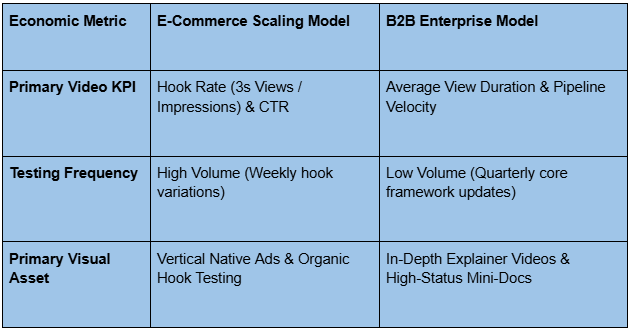
B2B Enterprise Acquisition: The Psychology of Risk Mitigation and Committee Consensus
While direct-to-consumer e-commerce thrives on transaction speed and impulsive emotional hooks, high-ticket B2B enterprise marketing operates on an entirely different psychological spectrum. If you try to sell a six-figure SaaS platform, corporate logistics contract, or institutional service using an e-commerce framework, your media efficiency will plummet to zero.
Enterprise client acquisition is not an individual sport. Modern procurement processes involve buying committees consisting of six to ten distinct corporate stakeholders. Each layer of this committee has completely different professional objectives, distinct technical requirements, and highly sensitive internal agendas. Your commercial video assets must speak to all of them simultaneously without creating messaging fragmentation.
The Fear Matrix: De-Risking the Enterprise Purchase
The foundational driver behind any enterprise transaction is not optimization: it is risk mitigation. When an executive or procurement manager decides to buy your solution, they are not spending their own capital. They are spending corporate funds, which means their internal reputation, their professional credibility, and their job security are actively on the line. A bad direct-to-consumer purchase results in a minor return request; a bad B2B vendor selection can derail an entire division for a fiscal year.
Your video marketing strategy must act as a scalable tool that eliminates professional anxiety. Over 90% of businesses use video as a core marketing tool because of its massive impact on buyer consideration. More importantly, corporate accounts that engage with three or more targeted vendor videos show a 28% higher close rate alongside a dramatically compressed sales cycle.
[The Legacy B2B Approach] = Send a dense 40-page text whitepaper -> Shared with committee -> Stuck in procurement limbo for 90 days.
[The Video-Driven Model] = Send a 3-minute executive video overview -> Shared instantly internally -> Immediate alignment across stakeholders.
To achieve these metrics, you cannot rely on an old-fashioned corporate overview or a generic brand film. Accelerating enterprise pipelines requires a highly calculated video marketing funnel strategy that systematically checks every compliance, technical, and strategic box for the evaluation team.
Engineering the Multi-Stakeholder Content Matrix
Because a single video cannot effectively communicate with a Chief Technology Officer, a Chief Financial Officer, and an End-User simultaneously, you must split your corporate narrative into distinct, objective-oriented visual layers. This structural approach requires deep creative direction for video marketing to maintain consistent brand authority while delivering highly specialized messages across three critical buckets.
The Visionary Asset (C-Suite Focus): A high-level commercial presentation focusing strictly on macroeconomic outcomes, total cost of ownership reduction, and overarching business scale.
The Validation Asset (Technical Evaluators): A precise, high-proof demonstration video verifying architectural compatibility, data compliance protocols, and explicit deployment workflows.
The Proof Asset (Operations Management): A cinematic, human-led case study documentary focusing on real-world operational transitions and peer-to-peer validation from identical market leaders.
The B2B Distribution Law: In 2026, professional buyers do not want to fill out aggressive lead capture forms just to see how your product functions. Enterprise buyers watch an average of 14.3 product-related videos per week (Wyzowl 2026). If you gate your core validation media behind complex lead-capture systems, you are actively pushing qualified accounts straight to your competitors.
By executing this layered architecture throughout your commercial video production process, you equip your internal champions within the target account with the visual documentation they need to sell your services to their own internal board members..
Asset Lifespans and Creative Burn: The Hidden Variable in Creative Amortization
Understanding the psychological differences between a B2B buyer and an e-commerce consumer is useless if you do not understand how long your visual assets will actually stay alive in the market. In our experience producing campaigns across the Los Angeles landscape, the single biggest leak in marketing capital is not high day-rates for crews, it is the failure to calculate creative decay.
The shelf life of your video asset dictates how you amortize your production costs. If you spend $30,000 on a video that fatigues in two weeks, your unit economics collapse. If you spend that same $30,000 on an asset that yields returns for two years, your acquisition cost decreases over time.
The Creative Burn Rate Across Pipelines
The speed at which an asset loses its conversion power depends entirely on your distribution method:
The High-Velocity Direct-to-Consumer Engine: When you scale e-commerce products on Meta, TikTok, or YouTube Shorts, your assets are subject to aggressive algorithmic fatigue. Based on performance tracking across high-volume retail accounts, a winning direct-to-consumer video creative has an average high-yield lifespan of 14 to 21 days before the target audience experiences visual blindness and frequency caps spike your cost-per-click.
The Long-Cycle B2B Enterprise Engine: Conversely, an enterprise explainer or case-study documentary behaves like an appreciating corporate asset. Because the audience pool is tighter and distribution is highly targeted (via direct sales outreach, LinkedIn ABM, or high-intent search), a premium validation video carries an operational shelf life of 12 to 24 months.
Our Operational Insight:
Stop treating video production like a singular artistic event. For direct-to-consumer, you are building an interchangeable modular framework where hooks can be swapped out in post-production every week. For B2B, you are engineering an enduring structural pillar. If your production partner doesn't ask about your distribution channel volume before writing the script, they are designing an asset destined for premature creative decay.
How Last-Click Metrics Murder Top-Funnel Creative Capital
If you rely on standard last-click Google Analytics tracking or basic ad-account dashboards to measure your video performance, you are making critical strategic decisions based on completely poisoned data. The current privacy landscape and tracking limitations mean that standard attribution engines routinely misallocate conversion credit, forcing brands to kill their most profitable assets.
This tracking failure hurts both business models in completely opposite ways:
1. The E-Commerce Trap: Meta's View-Through Illusion
Meta and TikTok love to claim credit for every sale via view-through optimization. If a user skims past your direct-to-consumer ad on their feed, ignores it completely, but buys your product three days later through an organic Google search, the ad network will claim 100% credit for that conversion.
If you build your production budgets purely on ad network dashboards, you will end up over-funding repetitive retargeting ads while starving the cold-traffic, top-funnel creative assets that actually introduced new buyers to your ecosystem.
2. The B2B Trap: The Invisible Committee
In enterprise acquisition, your video is almost never the final click before a contract is signed. A procurement manager watches your technical explainer on LinkedIn, downloads no assets, but slacks the video link directly to their CFO. The CFO watches it on a completely different device, then types your URL directly into a browser to book a sales call.
Your tracking software will label that massive six-figure conversion as "Direct Organic Traffic," completely wiping out the measurable ROI of your top-funnel video investment.
Our Operational Insight:
We routinely witness LA brands pull the plug on premium top-funnel visual assets because their internal software reported "zero direct sales." In reality, those videos were the exact trust-signals driving the entire downstream pipeline. If you don't run regular incrementality testing, such as geographic holdout tests or clear "How did you first hear about us?" post-purchase surveys, you will continuously optimize for the final click while destroying the actual source of your revenue generation.
Capital Allocation and ROI Modeling: The Mathematical Framework for Video Spend
Most corporate marketing executives set their production budgets based on arbitrary aesthetic desires or whatever capital happens to be left over at the end of the quarter. This is financial negligence. If you do not know the exact mathematical relationship between your media spend, your customer acquisition cost, and your creative production asset lifespans, you are simply throwing capital at the wall and hoping for a miracle.
Managing the actual video production cost in los angeles requires a strict shift from subjective artistic evaluation to ruthless data modeling. Your financial model must look completely different depending on whether you are running a high-velocity direct-to-consumer e-commerce system or a high-ticket B2B enterprise pipeline.
The E-Commerce Formula: Ad Spend Capital Indexing
In direct-to-consumer e-commerce, your creative video budget cannot exist in isolation from your media buying capital. Because creative fatigue sets in rapidly across algorithms like Meta and TikTok, your video spend must scale symmetrically alongside your projected monthly ad spend.
To maintain healthy unit economics, top-performing retail operators budget their video assets using the Creative Capital Index framework:
Creative Capital Index = Projected 90 Day Ad Spend x 0.20
Where:
Creative Capital Index: The total dollar amount of capital required to fund asset production and creative variations for a campaign.
Projected 90-Day Ad Spend: The total planned media budget to buy ad placements over the next three months.
0.20: A 20% allocation benchmark used to ensure that creative production receives enough funding to prevent ad fatigue and maximize ad performance.
This formula dictates that twenty percent of your total projected testing capital must be allocated directly to producing visual variations, hook iterations, and performance-native assets. If you attempt to scale a fifty thousand dollar monthly ad account with only a single two thousand dollar video asset, your return on ad spend will hit an immediate wall due to ad saturation.
You must view your production budget as a constant, necessary percentage of your total acquisition engine rather than a one-time project fee.
The B2B Formula: Pipeline Value and Contract Asset Allocation
For high-ticket enterprise B2B pipelines, budgeting based on ad spend metrics is completely ineffective because your primary distribution channels often prioritize organic trust, direct sales outreach, and account-based retargeting. Instead, your investment in video creative must be indexed against your expected target contract value and sales velocity.
The strategic equation for enterprise asset planning uses the Contract Asset Allocation model:
Max Enterprise Video Budget = Expected 180 Day Pipeline Value x 0.05
Where:
Max Enterprise Video Budget: The maximum justifiable amount to spend on video marketing and production.
Expected 180-Day Pipeline Value: The total estimated revenue potential of active sales deals that are projected to close within the next six months.
0.05: A 5% strategic budget cap used to ensure content costs stay strictly proportional to near-term revenue opportunities.
If your objective is to close one million dollars in new recurring revenue over the next two quarters, investing fifty thousand dollars into a high-status corporate mini-documentary and a suite of technical validation explainers is entirely mathematically sound. A five percent capital allocation to permanently de-risk your sales process, reduce procurement friction, and align internal buying committees is one of the highest-leverage investments your business can make.
Production Cost Management: Striking the Efficiency Line
To keep your campaigns highly profitable, you must carefully control where every single dollar goes during the active creation phase. Misallocating funds to the wrong production elements is a critical operational trap.
E-Commerce Scaling
Where to Invest Capital : Professional sound spatial design, native talent casting, aggressive volume hook testing variations
Where to Cut/Minimize Costs: Oversized production crews, expensive studio sets, luxury camera line-item upgrades
B2B Enterprise
Where to Invest Capital : Premium script architecture, pristine data graphic animations, elite executive styling
Where to Cut/Minimize Costs: Trendy social media visual effects, excessive location hops, high-volume superficial ad variations
Sinking Capital into Visual Fluff Kills Your Marketing ROI
In Los Angeles, it is incredibly easy to find a crew that can make your company look like a movie studio while generating exactly zero dollars in pipeline revenue. Vanity aesthetics are a commodity. If your video asset lacks platform-specific optimization and a rigid narrative architecture designed to capture attention in the first three seconds, you are not marketing. You are simply funding an expensive art project.
True creative alpha does not come from a pricey camera lens. It comes from deep strategic alignment. Every frame, hook, and transition must map directly back to your business metrics, customer acquisition funnels, and core unit economics. When you strip away the fluff, the only metric that matters is whether your video assets convert attention into measurable revenue. Anything else is a poor allocation of capital.
Deploy Conversion-Focused Video with Junction Lads Production
Stop writing checks for pretty content that fails to sell. If you are ready to stop burning cash on unoptimized media and deploy a high-performance video engine that drives predictable business outcomes, it is time to shift your strategy.
Junction Lads Production builds conversion-focused video assets right here in Los Angeles. We engineer high-impact visual narratives tailored for TikTok, Reels, YouTube, and enterprise B2B funnels. We do not deal in vague awareness metrics, and we do not chase aesthetic trends without a clear monetization plan.
Connect with Junction Lads Production today to audit your creative strategy and build video assets that actually move your bottom line.
Frequently Asked Questions
1. Why is commercial video production in Los Angeles more expensive than in secondary markets?
Los Angeles commands a premium because of elite creative labor, union infrastructure, and competitive permitting costs. SAG-AFTRA daily minimums, specialized technician rates, and location fees inflate initial line items. The financial upside is efficiency. Experienced LA crews run tighter sets, reducing the risk of costly multi-day overages.
2. How do you calculate the true financial ROI of a B2B video asset?
Ignore views and impressions. Calculate ROI by measuring pipeline velocity acceleration and conversion lift in key funnel stages. If a $30,000 case study video increases your demo-to-close rate by 5% on a $100,000 enterprise product, the asset pays for itself within three closed contracts.
3. What is the fundamental difference in video unit economics between B2B and e-commerce?
B2B video focuses on defending high contract values and shortening long sales cycles. The upfront cost is amortized over months or years. E-commerce video lives and dies by immediate acquisition costs and ad account efficiency. An e-commerce video asset must convert viewers fast enough to yield positive returns against immediate media spend.
4. How do you amortize the production cost of a premium $50,000 commercial?
Spread the $50,000 production cost across the total media spend or projected usage window. If the asset runs for 12 months across a $500,000 ad spend budget, the creative production represents a 10% loading fee on your media. Track the asset performance against creative fatigue to determine when the amortization window closes.
5. Why do direct-to-consumer brands fail when scaling their video ad budgets?
They fail because of creative fatigue and rising platform costs. Brands scale spend without scaling creative variations. When the target audience sees the same visual hook multiple times, click-through rates plummet while acquisition costs spike. Scaling spend requires producing systematic hook and angle variations.
6. What minimum LTV to CAC ratio is required to justify cinematic production values?
For enterprise operations, aim for a baseline ratio of 3 to 1. If your customer lifetime value is exceptionally high, investing in cinematic narrative structure protects your brand equity during high-stakes sales conversations. For lower-margin e-commerce, a lower ratio is survivable only if cash velocity is immediate.
7. How exactly does video content accelerate the B2B sales cycle?
Video handles asynchronous prospecting. It answers core technical, financial, and logistical objections before a sales call even happens. By distributing an in-depth product architecture video to stakeholders early, you eliminate friction and reduce the number of exploratory alignment meetings required to close.
8. What are the primary cost drivers on an LA commercial production set?
The budget breaks down into crew labor, equipment rentals, and location logistics. Specialized roles like a Director of Photography or a precise Sound Recordist command premium day rates. Logistics like secure locations, staging areas, and proper insurance coverages represent fixed costs that cannot be cut without risking liability.
9. Why is digital video attribution broken, and how do you fix it?
Last-click attribution models fail because they award total credit to the final retargeting ad. Top-of-funnel cinematic videos build the initial demand but look unprofitable on paper. Fix this by using post-purchase surveys, monitoring branded search lift, and tracking total blended marketing efficiency ratios.
10. Should e-commerce brands prioritize creative volume or cinematic quality for social media ads?
Prioritize systematic testing structure over pure cinematic polish. A highly polished ad that hits the wrong consumer pain point will tank. You need clean, professional visual execution combined with multiple distinct hooks and narrative angles to discover what converts.
11. What is the hidden financial risk of relying entirely on cheap user-generated content?
User-generated content is excellent for social proof, but relying on it exclusively dilutes your brand authority. It signals a low barrier to entry and fails to communicate enterprise level engineering or product premiumization. A lack of high production value limits your ability to increase your average order value or command premium pricing.
12. How do you calculate Cost Per Acquisition when factoring in production fees?
Do not just divide ad spend by conversions. Add the creative production cost and agency management fees to your net media spend, then divide by total customers acquired. A campaign that looks highly efficient on raw ad spend can actually be net-negative once a massive upfront production cost is fully loaded.
13. What does Creative Alpha mean in high-performance video marketing?
Creative Alpha is the measurable performance lift generated purely by superior message architecture and visual execution, independent of ad account bidding algorithms. When media buying levers become commoditized, your video creative is the primary mechanism left to lower acquisition costs and win ad auctions.
14. When should a business deploy a webinar format versus a cinematic case study?
Deploy webinars when your target audience requires deep, step-by-step technical education to move from consideration to intent. Deploy a cinematic case study when you need to establish emotional validation, peer proof, and high-level enterprise credibility with executive decision-makers.
15. How does strategic narrative planning save capital during post-production?
Post-production costs escalate when editing teams have to hunt for a cohesive story in loose footage. Defining a rigid script, explicit storyboards, and clear delivery formats before the cameras roll ensures the editor executes a pre-approved blueprint. This eliminates endless revision rounds and costly hourly overages.
16. What is the true opportunity cost of cutting your video production budget?
Cutting budget usually means sacrificing the pre-production planning phase or hiring cheaper, slower crews. The immediate saving is wiped out by long, disorganized shoot days, poor audio capture, and weak hook variations. You save pennies upfront but lose dollars when the ad platform rejects unengaging creative.
17. How do you stop a commercial video campaign from turning into an unprofitable vanity project?
Bind the creative direction to clear conversion benchmarks before spending a single dollar. Every scene, line of dialogue, and visual framing choice must serve to isolate a prospect pain point, demonstrate a product solution, or resolve a buying objection. If a creative choice does not actively drive the conversion mechanism, cut it from the script.