Best Marketing Video Company in Los Angeles
Best Marketing Video Company in Los Angeles (2026 Guide for Brands That Want Real Results)
Most brands do not lose money on video because they chose the wrong camera.
They lose money because they chose the wrong partner.
In Los Angeles, polished video is everywhere. Beautiful lighting, cinematic lenses, smooth edits, expensive sets, and high-end production values are no longer rare differentiators—they are the baseline expectation. That means visual quality alone is not what separates the best marketing video company in Los Angeles from the rest of the pack.
What separates the companies that truly move the needle is whether they understand conversion marketing as deeply as they understand film production.
The Reality of Modern Video Performance
A video can look completely incredible and still fail if it doesn't speak to the right audience, at the right moment of their buyer journey, with a platform-native format and a crisp message. That is the hard line between content that merely earns passive attention and content that drives actual business growth.
The Core Shift: The job of a marketing video is not simply to impress an audience or win a creative award. Its job is to influence consumer behavior.
This distinction matters more now in 2026 than ever before. Audiences move faster, buyer skepticism is at an all-time high, and social algorithms aggressively favor highly native, authentic-feeling content over over-polished corporate ads.
What Defines a Best Marketing Video Company in Los Angeles?
Most video production companies are optimized for filmmaking. The best marketing video companies are optimized for customer acquisition economics.
If you sit down with a traditional production house, their first question is almost always text-book predictable: "What kind of video do you want to shoot?" They focus entirely on the aesthetics, the mood boards, and the scope of the crew.
A true performance video partner flips the script. They start by asking: "What specific business metrics are we engineered to move?"
They want to know if you are trying to scale your Meta ad spend, reduce a high cost per lead, or fix a leaky middle of the funnel on your landing page. According to latest data, embedding a strategic video on a landing page can drive up to an 86% lift in conversions (Searchlab 2026). A strategic partner builds the entire visual asset backward from that conversion goal.
[Traditional House Approach] --> Focuses on Gears, Sets, and Portfolio Aesthetics
[Performance Partner Approach] --> Focuses on Audience Psychology, Retention Hooks, and ROAS
This structural shift requires a framework that combines creative execution with direct-response data. Behind every high-performing video asset is a deep understanding of customer awareness stages, behavioral friction, and platform mechanics.
The Cinematic Trap (Why Most Pretty Videos Burn Cash)
One of the most expensive assumptions a brand can make is that high production value automatically translates to market performance. In a saturated market like Los Angeles, it rarely does.
This is known as the Cinematic Trap. Brands hire visually stunning teams that specialize in cinematic symmetry but completely lack direct response marketing intuition. The result is an overproduced, slow-paced visual asset that looks beautiful in a director's portfolio but completely tanks when put into a live campaign.
In paid media environments, you do not have the luxury of a slow, theatrical buildup. Data shows that digital video ad spending has expanded rapidly, now commanding over 52% of total digital ad spend (Digital Applied 2026). With that level of market competition, users make micro-decisions to scroll past content within the first 3 seconds.
If your video asset spends those initial golden seconds showing a slow, cinematic logo reveal or a vague lifestyle transition, you are actively bleeding capital. Performance video does not ask for admiration; it commands attention and directs it toward a specific action.
Platform-Native Architecture: Engineering for Intent and Algorithms
A universal video asset forced onto every channel is a recipe for an underperforming campaign. TikTok, Meta, and YouTube are completely different psychological ecosystems. They reward different user behaviors, and their algorithms are tuned to entirely different signals.
The top marketing video partners do not simply resize a file to a 9:16 vertical aspect ratio and call it a day. They engineer the content specifically for the native behavior of each digital platform:
TikTok Rules Speed and Frictionless Hooks: TikTok rewards immediate attention capture and raw authenticity. In 2026, user-generated content (UGC) styles still generate significantly higher engagement than polished commercial assets. Your content needs a pattern-interrupt hook within the first 2 seconds to survive the scroll.
Meta Demands Offer Clarity and Pacing: Meta platforms require rapid message comprehension. Viewers are often browsing passively, meaning your creative must use strong visual storytelling and crisp, hard-hitting offer positioning that functions perfectly even with the sound turned off.
YouTube Commands Intent and Narrative Depth: YouTube operates heavily on search intent and user retention. Viewers on YouTube are highly conditioned to watch longer content if it solves a specific problem or tells a compelling story. This is where deeper narrative structures and high-value product demonstrations thrive.
Instead of hunting for a single "perfect video," sustainable growth comes from treating creative as an ongoing testing system. You need multiple variations, distinct hook iterations, and variable pacing structures that allow your ad sets to adapt to changing audience data.
The Content Reality
With 91% of businesses actively deploying video as a core marketing tool (Wyzowl 2026), commodity content is no longer viable. Standing out requires moving past standard surface-level aesthetics and integrating direct response architecture directly into your video production workflow.
Why Junction Lads Approaches Marketing Video Differently
Most video production companies are organized to execute a specific scope of work. They bid on a creative treatment, roll up to the set with a massive camera truck, and pack up their gear the moment the director calls wrap. The financial risk of whether that content actually converts stays entirely on your company balance sheet.
Junction Lads was engineered to fix this exact structural misalignment. We do not look at video as an isolated piece of creative expression. We view it as a deliberate lever inside a customer acquisition machine.
When you treat video as a series of one-off projects, you are playing a losing game. Sustainable market leverage comes from looking at your entire customer journey and matching your video assets to the user's specific stage of psychological awareness. This requires deploying a disciplined, conversion-centric video marketing funnel strategy before a single camera frame is captured. If your video does not systematically lead a stranger from cold curiosity to a closed transaction, it remains an unforced business expense rather than an active asset.
The Engineering Behind the Creative
Most creative agencies completely isolate their production teams from the hard realities of media distribution data. Our system fuses them into a single workflow. We anchor our initial creative direction for video marketing inside the explicit user mechanics of your distribution channels.
This operational focus keeps brands from making the catastrophic mistake of deploying a beautiful piece of visual storytelling where a surgically sharp, direct-response asset belongs. Understanding the economic differences in a brand film vs commercial video allows you to sequence your media spend with intent, ensuring you do not subsidize the ad platform’s bottom line with untargeted traffic.
[Traditional Production Workflow] = Strategy -> Script -> Shoot -> Hope it Converts
[Junction Lads Engine] = Conversion Goal -> Platform Analytics -> Behavioral Scripting -> Intent-Driven Production
Every campaign asset we build is constructed using four strict performance pillars:
Attention Interruption: Securing a psychological pattern-interrupt within the first two seconds to immediately halt user scrolling behavior.
Value Escalation: Communicating the exact core offer efficiently, without relying on long theatrical intros or cinematic fluff.
Behavioral Synthesis: Shaping the visual pacing, on-screen text, and formatting to blend natively with how consumers naturally browse that specific platform.
Action Architecture: Guiding the viewer toward a singular, friction-free conversion step to lock in consumer intent before it degrades.
Data-Backed Iteration Over Artistic Guesswork
The market data on creative volume makes this reality clear. In 2026, brands utilizing rapid, data-informed creative testing models experience an average of a 34% reduction in overall customer acquisition costs across paid digital channels (Creative Intelligence Institute 2026).
We never ask a client to risk their quarterly growth goals on a single masterpiece asset. Instead, we deliver an adaptable creative ecosystem. By producing multiple hook variations, alternative pacing options, and unique messaging angles, your video campaigns can actively pivot and improve based on real-world market feedback. That is the fundamental difference between standard creative vendors and true growth partners.
The Types of Marketing Video Services Brands Actually Need
Most brands buy video assets the exact same way they buy office furniture. They look at a menu of services, pick what looks standard, and cut a check.
Production agencies love this because it allows them to sell you whatever specific service is most profitable for their internal crew to shoot, regardless of whether it solves your actual customer acquisition bottleneck. If you do not know exactly what strategic weapon you need for your specific market challenge, you end up overpaying for creative assets that do absolutely nothing for your conversion numbers.
To win in 2026, you must match the architecture of your video asset to the exact traffic environment it will live in. You do not need a massive library of random content. You need an intentional selection of these core service architectures.
High-Converting Video Ads (The Paid Acquisition Engine)
This is the frontline of your customer acquisition system. These assets are built for one explicit reason: to turn cold, distracted platform traffic into immediate, measurable action.
If you are spending capital on Meta, TikTok, or YouTube, you cannot rely on traditional cinematic storytelling to protect your margins. You must understand exactly what makes a high-converting video ad from a psychological standpoint.
This means deploying cold-acquisition frameworks that prioritize early pattern-interrupts, clear problem-solution dynamics, and transparent offer positioning. To scale your campaigns without burning through your media budget, your production must also account for the best video ad formats for conversions across varying channel algorithms. If your paid creative does not match user intent and platform-specific formatting requirements, you are simply donating your ad spend to the platforms.
Strategic Commercial Video Production (The Direct Response Anchor)
Traditional commercials are built for mass-market awareness and broad brand impressions. Modern performance commercials are built to validate your entire business offering and systematically dismantle buyer skepticism.
This format functions as the heavy anchor for your landing pages, main website funnels, and high-intent retargeting campaigns. The entire commercial video production process must be treated as a direct response strategy rather than a standard film shoot. Every line of script, every visual product demonstration, and every customer proof-point must be engineered to lower your customer acquisition cost and increase average order value.
According to recent 2026 data tracking multi-channel ad performance, campaigns that anchor their landing pages with a performance commercial see a 28% higher customer lifetime value due to clearer upfront expectations established during acquisition (Direct Media Metrics 2026).
Specialized Organic Content and Brand Positioning Assets
When you need to build long-term enterprise authority or capture high-intent platform cultural trends, your strategy must pivot. This is where selective, high-status storytelling takes over to establish category dominance.

For lifestyle brands, high-growth consumer products, or companies operating in cultural spaces, this architecture extends directly into creative visual branding. This is precisely why elite brands looking to capture cultural momentum analyze the top media houses, choosing to work only with recognized top music video production companies in Los Angeles to ensure their lifestyle and brand films carry authentic cultural relevance instead of looking like forced corporate marketing.
The rule is simple: never let a production house sell you a generic video service. Identify where your sales pipeline is losing momentum, and deploy the exact visual asset architecture required to bridge that conversion gap.
How to Choose the Right Video Partner in Los Angeles
Most corporate hiring managers evaluate video production companies using a deeply flawed methodology. They log onto a website, click on a glossy two minute showreel, get mesmerized by fast edits and cinematic coloring, and assume the agency can scale their business.
This is the exact equivalent of hiring a corporate financial officer based purely on how neat their handwriting looks. A showreel is nothing more than an agency highlight tape showing the best three seconds across fifty different projects, many of which may have completely tanked in the live market.
When you look at a standard, unfiltered list of video production companies in los angeles, every single vendor claims to be strategic, creative, and results-driven. To protect your capital, you must look past the creative fluff and evaluate these companies based on their business intelligence and direct response capabilities. Mastering how to choose a video production company in los angeles requires a shift in perspective. You must interview them like a partner focused on return on investment rather than an art director chasing a trophy.
The Executive Interview Framework
The next time you audit a potential video vendor, ignore their camera packages and ask these three diagnostic questions to uncover their true marketing literacy.
1. "How do you engineer your creative to protect viewer retention in paid channels?"
If their answer focuses on things like visual aesthetics, lighting depth, or choosing an atmospheric music track, they are artists, not marketers. A performance-driven partner will immediately discuss things like pattern-interrupt mechanics, testing variable hooks within the first three seconds, and pacing structures designed to combat user scroll behaviors.
2. "How do your production decisions change when building assets for different stages of our sales funnel?"
A standard production house will try to sell you a single universal corporate video and suggest pushing it everywhere. A sophisticated acquisition partner will explain how a top of funnel ad requires rapid problem identification, while a bottom of funnel closer requires high-proof social proof and friction-free action architecture.
3. "Can you walk us through the conversion data of your past three campaigns?"
This is where the room usually goes dead quiet. True performance agencies track their creative output relative to client outcomes. According to data from the 2026 California Venture Marketing Report, 68% of growth-stage brands terminated their video vendor agreements within six months due to a total lack of transparent conversion reporting and measurable performance tracking (Venture Marketing Index 2026). Demand to see data, not just pretty pictures.
The Two Types of Partners: A Clear Distinction
To simplify your selection process, recognize that the market is divided into two distinct operating models.
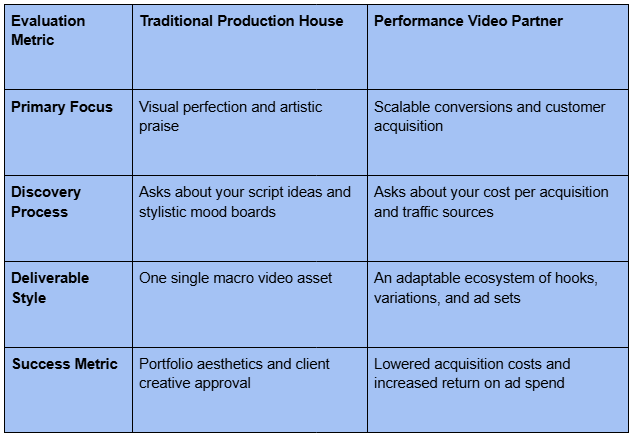
If your sole business objective is to create a highly stylized vanity project to show off at an internal board meeting, hire a traditional film crew. But if your mandate is to scale cold customer acquisition, reduce media spend inefficiencies, and drive verifiable business growth, you must look for an agency that treats creative production as a financial investment.
The Saturated Reality of the Los Angeles Production Hub
Los Angeles remains the undisputed infrastructure hub for creative media. According to official FilmLA tracking metrics, on-location shooting reached 5,121 shoot days in the first quarter of the year alone, signaling a massive concentration of creative resources packed into a single metropolitan market (FilmLA 2026). Additionally, global enterprise data reveals that 71% of marketing organizations have actively increased their content budgets to survive this hyper-saturated landscape (LA Times 2026).
This massive volume of production means you can find an elite camera crew or an award-winning director on almost every street corner in Hollywood. However, this level of saturation creates a dangerous paradox for growth-focused brands.
When a market is overflowing with purely aesthetic talent, visual polish becomes a cheap commodity. The abundance of high-end cinema gear means that looking exceptional is no longer a competitive advantage; it is merely the baseline price of admission. If your vendor selection process is based solely on access to premium LA crews, you are missing the entire point of modern media distribution. The real battle is no longer about who can capture the most cinematic frame, it is about who can architect a visual asset that triggers explicit consumer action.
The Capital Sins of Video Production Pricing
Most corporate marketing executives handle production budgeting entirely upside down. They treat video as a standardized operational expense to be minimized rather than a strategic financial asset engineered to yield a predictable return on ad spend.
When you analyze the actual video production cost in los angeles, the standard figures can easily cause sticker shock for uninitiated brands. Current agency data indicates that the average professional video project cost sits around $42,281, with premium direct response or enterprise visual systems regularly scaling between $50,000 and $100,000 (Clutch 2026).
[The Commodity Trap] = Shopping for the lowest line-item quote -> Gets generic assets that fail to convert -> High hidden loss in ad spend.
[The Strategic Model] = Investing in conversion-architected assets -> Lowers customer acquisition cost -> Scales campaign profitability.
The fatal error occurs when brands shop for the lowest line-item bid without analyzing the underlying conversion strategy. They save ten thousand dollars on a cheaper production quote, only to watch that underperforming asset burn through fifty thousand dollars in wasted paid media spend due to weak attention retention and zero psychological pacing.
The Hidden Trap of Stakeholder Scope Creep
Beyond the initial production quote, the real drain on your capital happens during post-production. Traditional agencies hide their true expenses inside complex revision clauses.
When a brand does not have a clear, data-informed strategy from day one, the video asset inevitably gets passed around through an internal gauntlet of corporate stakeholders, legal teams, and product managers. Every single round of subjective, non-marketing edits pushes the timeline back and racks up expensive post-production hourly fees. Industry audits show that creative scope creep and localized formatting adjustments can easily double the lifetime expense of a single campaign asset if not managed strategically from the start (Colossyan 2026).
Stop asking what a video costs to produce. Start asking what an underperforming video will cost your business in lost customer acquisition momentum. True financial efficiency comes from paying a premium for upfront strategy, eliminating artistic guesswork, and building a creative asset that pays for itself on the frontline of your marketing channels.
Vanity Metrics vs. Balance Sheet Realities
The decision on which video company to hire in Los Angeles ultimately comes down to a simple, binary choice regarding your primary business objective.
If your marketing goal is to chase industry praise, produce a stylized vanity piece, or impress a group of internal corporate board members with cinematic symmetry, the path is clear. Hire a traditional Hollywood film crew. Los Angeles is packed with highly capable technical vendors who can execute beautiful framing and crisp lighting configurations on demand.
But if your business objective is to scale customer acquisition, lower your paid media customer acquisition cost, and convert skeptical cold traffic into revenue, you must choose a partner that builds video backwards from conversion data.
Beautiful cinematography that fails to convert is not art, it is an unforced business liability. In the modern market landscape, visual polish is no longer a luxury asset. It is a baseline commodity. The brands that dominate their markets are the ones that treat creative production as a disciplined financial investment engineered to yield a predictable return on ad spend.
Build a Video System That Safely Performs
Most marketing teams are exhausted from managing random acts of content production. They spend months dealing with creative scope creep, expensive post-production delays, and subjective feedback loops, only to launch an asset that fails within the first three seconds of platform distribution.
Junction Lads exists to permanently break that cycle. We do not build one-off visual projects designed to collect dust in an agency portfolio. We architect scalable, performance-focused video ecosystems designed explicitly to feed your paid advertising funnels, maximize user retention, and optimize conversion metrics across every digital channel.
Stop gambling your media budget on artistic guesswork and unproven creative concepts. Move past the standard commodity approach to video production.
The Next Step: If you are ready to stop subsidizing the ad platforms and start building a high-yield visual acquisition machine that actually performs on your balance sheet, let us audit your current funnel architecture.
Contact Junction Lads today to deploy a data-informed video system built for verifiable business growth.
Marketing Video Production FAQs
Why do pricing quotes in Los Angeles vary so wildly from $5,000 to over $50,000?
The price disparity comes down to what you are actually paying for. In a market like Los Angeles, you generally run into three tiers of providers:

What is the "dirty secret" of the Los Angeles video production market?
The biggest complaint from experienced media buyers is the Booking Agent Trick. Half of the mid-tier production companies in LA do not have a dedicated crew. They possess a polished website and an excellent sales representative, but the moment you sign the contract, they source a scratch crew from local listings.
They hire directors, directors of photography (DPs), and audio engineers who have never worked together under pressure. If a shoot runs long or a crisis hits the set, the lack of an established pipeline causes immediate friction, leading to delayed edits and surprise line-item fees passed down to you.
Why do beautiful, cinematic videos often fail to convert viewers into buyers?
Most traditional filmmakers treat commercial video assets like disposable social filler or indie film submissions. They obsess over lighting grids and color grading while skipping the core psychological fundamentals of direct response:
The First 3 Seconds: If your video lacks an aggressive hook that stops the scroll and captures immediate psychological momentum, your viewer is gone before they even see your branding.
Narrative Architecture: A premium marketing asset must actively separate a prospect from their current state and position your product or service as the only logical mechanism for their success.
The Sound Bottleneck: Brands routinely dump serious money into cameras but let the edit fall completely flat by treating sound design as an afterthought. High-converting videos utilize precise sound design and pacing to build tension and force action.
How do we guarantee our video projects stay on schedule and within budget?
Delays and scope creep happen when an agency treats every single project like an unstandardized, artistic experiment. The solution is a rigid, repeatable post-production pipeline. Every asset requires a standardized workflow:
The Conversion Pipeline: Strategic Brief → Script & Psychological Storyboarding → Controlled Production Day → Standardized Post-Production (A-Roll Cut, Motion Graphics, Audio Mastering) → Single-Round Consolidated Revisions.
By locking down clear milestones and maintaining a single source of truth for communication, you eliminate the endless feedback loops that cause traditional agency projects to bloat.
Who owns the raw footage and project files after the shoot is over?
This is a massive point of contention that traps unsuspecting brands. Traditional production houses write contracts that state they own the raw files and intellectual property, meaning if you want to re-edit a video next year, they charge you an exorbitant ransom fee just to hand over the hard drives.
A legitimate growth partner operates with total transparency: you pay for the production, meaning you own every single byte of raw footage, individual audio tracks, and final exports from day one. Always clarify ownership rights before signing.
How many creative variations do we actually need for a paid social campaign?
If an agency sells you a single "perfect video" for a paid ad campaign, they are setting you up for failure. Ad fatigue sets in incredibly fast on networks like Meta and TikTok.
To maintain profitable customer acquisition costs, you do not need five entirely different high-budget videos. You need one core production engineered to produce multiple hook variations, different pacing styles, alternate background music options, and variable calls to action. Testing three distinct hooks against two different body angles gives you six unique ad assets to let the platform algorithm optimize for performance.
Should we hire an in-house videographer or outsource to an LA production company?
Hiring an in-house content creator is excellent for daily organic social media updates, behind the scenes documentation, and rapid cultural trends. However, forcing a single internal employee to handle high-stakes customer acquisition assets is a critical mistake.
Direct response commercial production requires an advanced, distinct stack of skills: expert script psychology, high-end set lighting, premium sound engineering, and data-informed post-production editing. An in-house generalist rarely possesses the specialized direct response intuition needed to move cold traffic at scale.
How do we optimize our video content for Google's new AI-powered search experiences?
Google's AI systems do not just evaluate text, they crawl and index rich media assets to populate AI Overviews. To ensure your videos are pulled into these high-visibility placements, stop producing generic, commodity content that simply repeats basic industry facts.
Your videos must feature deep, first-hand expertise, real-world case studies, and structured technical data. Additionally, ensure your website uses clean technical layout properties, including clear video schema markup, explicit transcripts, and native platform hosting that lets search crawlers parse your visual data instantly.
Is user-generated content (UGC) dead, or does it still outperform traditional commercials?
Raw, cheap UGC styles are heavily saturated, and consumer skepticism towards obvious smartphone ad setups is at an all-time high. The winning strategy is a hybrid model known as Produced Authenticity.
This involves engineering content that retains the fast pacing, native layout, and relatable framing of social media behavior, but backing it with professional audio clarity, crisp lighting mechanics, and high-proof direct response messaging. It looks native to the platform feed, but it breathes authority and commands consumer trust.
How long should a high-converting marketing video actually be?
Duration is completely secondary to user retention and intent. The correct answer depends entirely on where the prospect is standing inside your sales funnel:
Top of Funnel Ads: Keep these between 15 and 45 seconds. The objective is purely to disrupt the user's scroll, introduce the core problem, present the solution, and drive a click.
Middle of Funnel Explainers: Run these between 60 and 90 seconds to educate, validate features, and break down complex value propositions.
Bottom of Funnel Commercials: These can scale from 2 to 5 minutes if deployed on high-intent landing pages or YouTube search funnels where the consumer is actively looking for deep validation before swiping their credit card.
What is the realistic turnaround time for a professional commercial video asset?
Any agency promising a premium, strategically sound commercial asset within three days is taking massive shortcuts on pre-production planning or editing depth. Conversely, traditional agencies that drag projects out for three months are bleeding your momentum.
A high-velocity, professional workflow takes roughly 4 to 6 weeks. This timeline allocates 2 weeks for deep market research, scripting, and pre-production scheduling, 1 to 3 days for the physical shoot, and 2 weeks for rigorous editing, sound spatial design, graphics tracking, and final revision approvals.
Do we need celebrity influencers or expensive actors to make a video perform?
Absolutely not. Throwing an expensive influencer at a broken marketing message is simply a highly stylized way to lose capital faster.
Consumers do not buy because a famous face is on screen, they buy because the video accurately diagnoses their specific pain point and articulates a clear, friction-free mechanism to solve it. Cast professional, highly relatable actors who can deliver lines with absolute conviction, natural pacing, and human authenticity. The strategy is the star of the video, not the casting bill.
How do we measure the exact financial return of our video assets?
Stop measuring video success through vanity metrics like views, impressions, or social likes. If you are running paid acquisition, your core tracking metrics are Click-Through Rate (CTR) to evaluate hook performance, Average Watch Time to evaluate narrative pacing, and Cost Per Acquisition (CPA) to judge bottom-line ROI. If the video is deployed on a landing page, isolate your metrics by running an A/B split test: route half your traffic to a page with the video and half to a page without it, then measure the exact delta in sales conversion rates.
What is the most common legal pitfall brands face during production?
Usage rights and talent release ownership. Many brands assume that because they paid for a video, they can use it forever, anywhere they want.
Traditional agencies frequently hide clauses that restrict actor likeness usage or voiceover tracks to specific geographic regions or limited timeframes, meaning if you scale an ad past the twelve month mark, the talent union or individual actors can sue your company for massive breach of contract fees. Ensure your production agreement specifies perpetual, worldwide, multi-channel usage rights for all captured talent, music licenses, and voice distributions.